Laser welding offers manufacturing companies the opportunity to make welding processes more precise, faster, and increasingly automated. However, switching from a conventional welding process to laser welding should not simply be regarded as replacing one welding technology with another. The greatest potential is achieved when the component design, tolerances, clamping technology, and entire production process are adapted to the requirements of laser welding from the outset.
This guide provides companies using a Vision Lasertechnik laser welding system for the first time with a concise overview of the most important technical and organizational aspects.
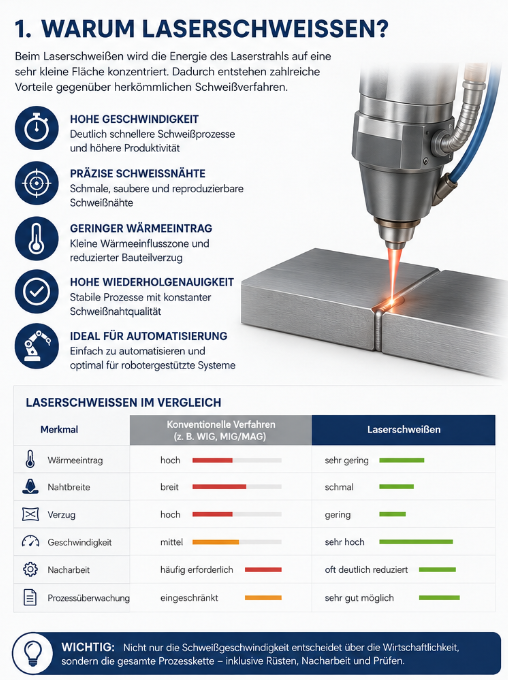

In laser welding, the energy of the laser beam is concentrated onto a very small area. This allows metallic materials to be locally melted and joined. Compared with TIG, MIG/MAG, and other conventional welding processes, the amount of heat introduced into the component is often significantly lower.
This results in several key advantages:
Particularly with thin-walled or precision components, the low heat input can be a decisive advantage. Whereas a component welded using a conventional process may subsequently require straightening, grinding, or other finishing operations, a properly designed laser weld can sometimes already achieve the required final quality.
The economic benefits should therefore not be assessed solely on the basis of welding speed. The entire process chain is important – including setup, clamping, post-processing, inspection, and handling.
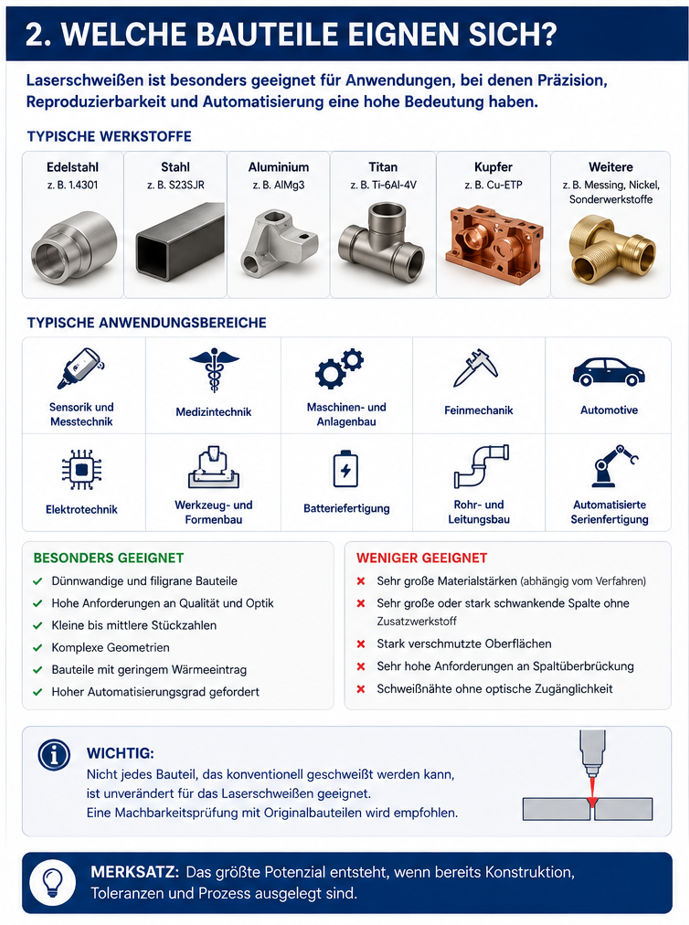
Laser welding is particularly suitable for applications where precision, repeatability, and automation are important. Typical materials include stainless steel, steel, and titanium as well as – with appropriately adapted laser and process technology – aluminum, copper, and other metallic materials.
Typical applications can be found in areas such as:
However, it is important to understand that not every component that can be welded conventionally is automatically suitable for laser welding without modification.

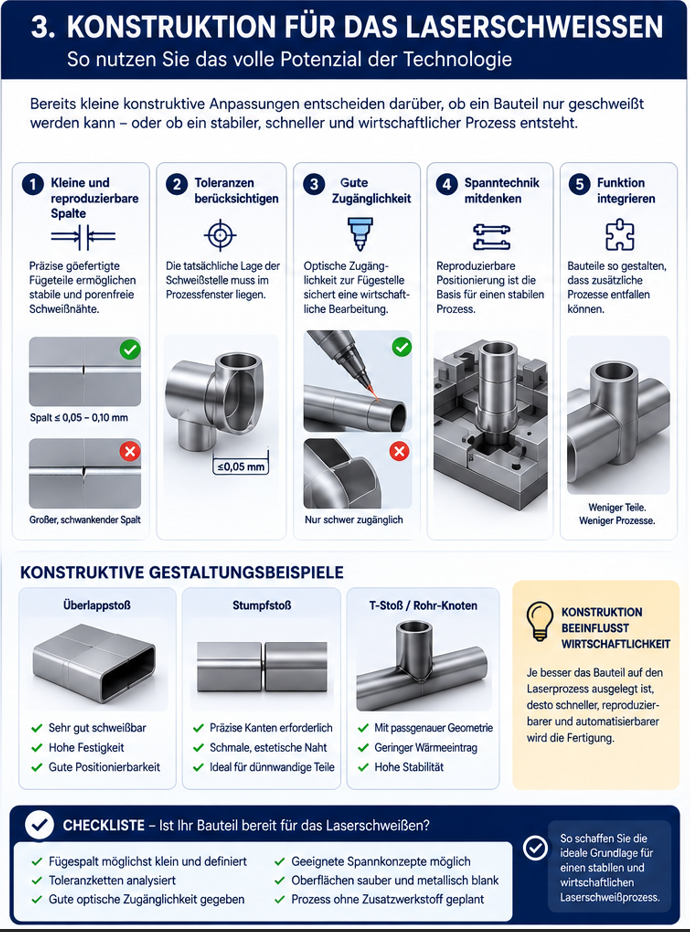
One of the most common mistakes when introducing laser welding is attempting to weld a component originally designed for TIG or MIG/MAG using a laser without making any modifications.
Laser welding places different requirements on component design.
Because the laser beam is highly focused, its ability to bridge large joint gaps without filler material is limited. Components should therefore be manufactured and positioned as precisely as possible.
Instead of compensating for large gaps with additional welding material, the component design should provide a defined and reproducible joint configuration wherever possible.
It is not only the tolerance of the individual components that matters. The resulting position of the weld joint after assembly is critical.
Tolerance chains should therefore be considered during the design phase. In automated processes, the actual weld position must remain within the deviations that can be reliably handled by the process, optics, sensor technology, and, where applicable, automatic path correction.
The laser generally requires suitable optical access to the joint. Components should therefore be designed so that weld seams can be reached without unnecessarily complex beam guidance.
With robot-assisted systems, however, weld positions can be approached from different angles. This provides significantly greater design freedom than systems based exclusively on linear axes.
Reproducible component positioning is essential for a stable process. A suitable fixture should securely locate the components and control the joint gap without unnecessarily restricting access for the laser beam.
The good news is that laser welding generates virtually no mechanical process forces. As a result, clamping concepts can sometimes be significantly simpler than those required for machining processes.
One of the particular strengths of laser welding is its suitability for automation. Laser power, pulse parameters, movement, shielding gas, and other process variables can be controlled with a high degree of repeatability.
This makes the process ideally suited for automated production cells.
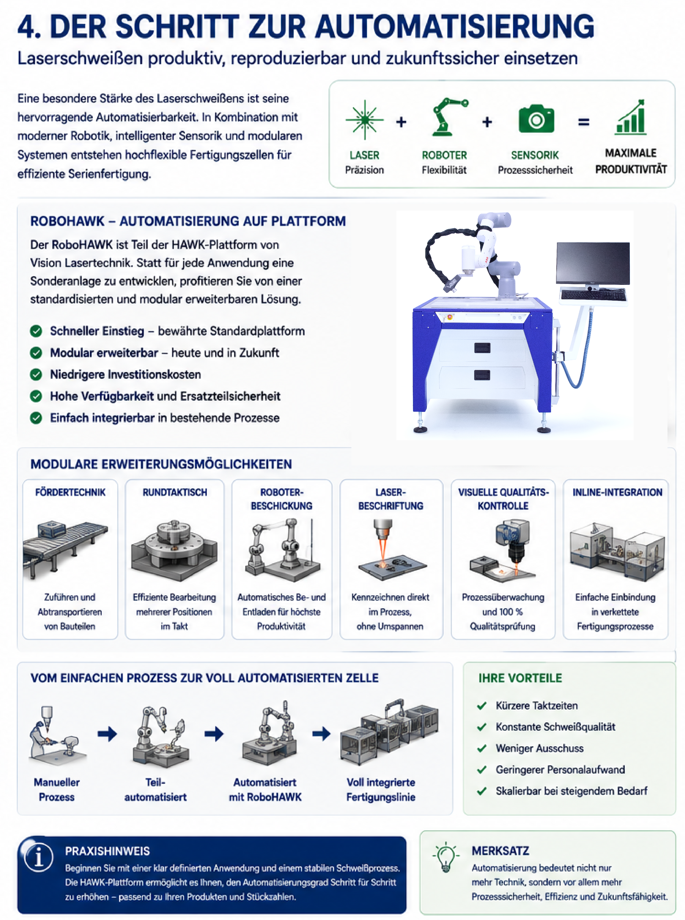
With the RoboHAWK, Vision Lasertechnik follows a platform-based approach. Instead of developing a completely new special-purpose machine for every application, the system is based on a standardized, modular, and expandable automation platform.
The integrated 6-axis robot enables the processing of complex three-dimensional component geometries and allows welding positions to be approached that would be difficult to reach with conventional XYZ systems.
Depending on the application, the HAWK platform can be expanded with conveyor systems, rotary indexing tables, automated loading, laser marking, or visual quality inspection, for example. Subsequent integration into interconnected production lines is also possible.
This allows a company to start with a comparatively simple production process and subsequently increase the level of automation as production volumes or requirements grow.
This offers significant advantages, particularly for recurring components or tray-based production. Once the process has been set up, predefined welding programs can be executed with a high level of repeatability. The actual production process therefore requires considerably less welding expertise than a manual welding process.
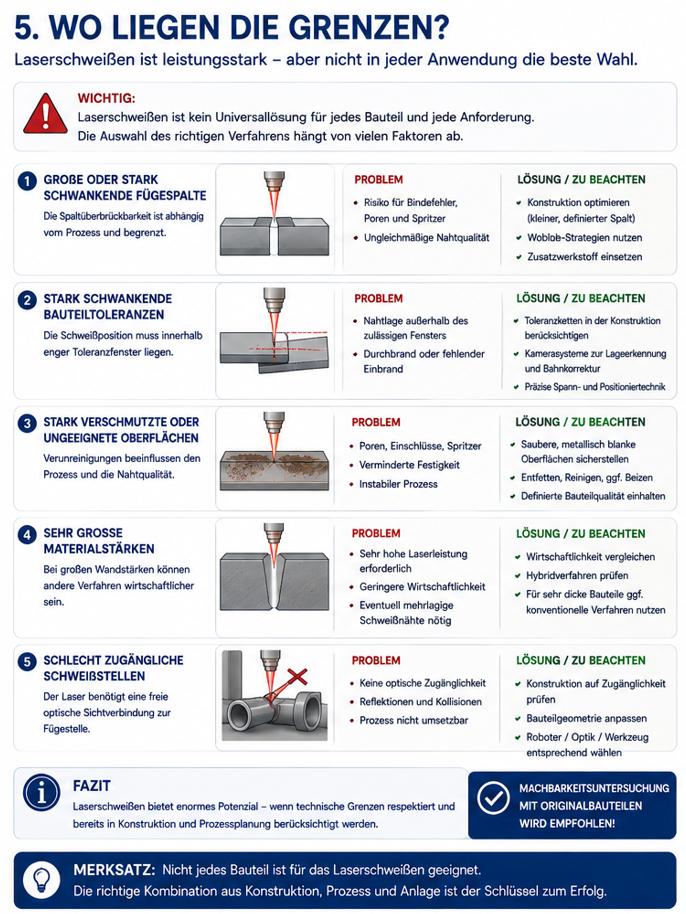
Laser welding is not a universal replacement for every other welding process.
The following conditions can be particularly challenging:
Large or Highly Variable Joint Gaps
Depending on the process strategy, the ability to bridge gaps may be limited. Design modifications, wobble strategies, or filler materials may be required.
Large Variations in Component Tolerances
When a weld seam is processed automatically, the joint must be located within a sufficiently defined position. If larger deviations occur, camera systems or other methods for position detection and path correction may be required.
Heavily Contaminated or Unsuitable Surfaces
Oils, oxides, coatings, or other contaminants can influence the process and cause porosity, spatter, or other weld defects. Defined and consistent component quality is therefore particularly important in automated series production.
Very Thick Materials
For large material thicknesses, conventional welding processes or hybrid processes may be more economical. The technically achievable penetration depth alone is therefore not a sufficient criterion when selecting the appropriate welding technology.
Poorly Accessible Weld Locations
The laser requires suitable optical access. Even a 6-axis robot cannot process a joint if the component geometry completely obstructs the beam path.
A feasibility study using original components is therefore generally recommended before the final configuration of a production system is determined.
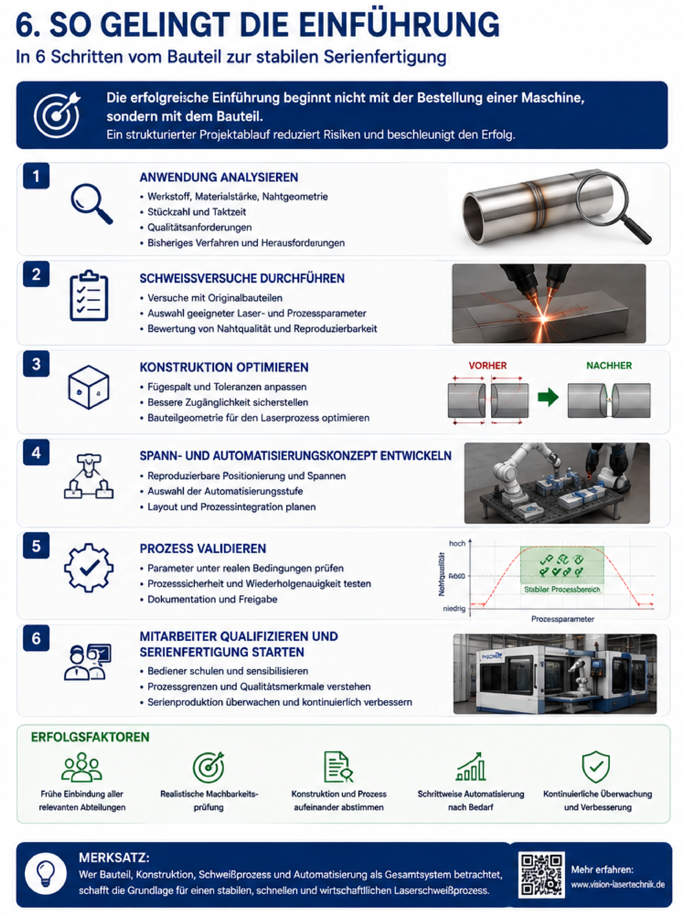
The successful introduction of laser welding does not begin with ordering a machine – it begins with the component.
A practical project sequence is:
1. Analyze the Application
Consider the material, material thickness, joint geometry, production volume, quality requirements, and the welding process currently being used.
2. Conduct Welding Trials
Original components are used to determine whether the required joint can be produced reliably.
3. Optimize the Component Design
Joint gaps, tolerances, accessibility, and component geometry are adjusted to the laser process where necessary.
4. Develop the Clamping and Automation Concept
Only once a stable welding process has been established should it be determined how components will be located, positioned, welded, and, where appropriate, automatically loaded and unloaded.
5. Validate the Process
The developed parameters are tested and documented under realistic production conditions.
6. Train Employees and Start Series Production
Operators do not need to become laser specialists. However, they should understand the process limits, quality characteristics, safety systems, and how to respond to process deviations or faults.
The greatest benefit of laser welding is not achieved simply by replacing an existing welding torch with a laser.
Instead, companies should consider the component, design, welding process, and automation as one integrated system.
Companies that take small joint gaps, reproducible tolerances, and good accessibility into account during the design phase create the foundation for a stable and highly automated production process.
Modern laser welding systems therefore offer much more than higher welding speeds. They can reduce distortion and post-processing, improve repeatability, and enable production processes that would be difficult to implement economically using manual welding methods.
Systems such as the T-Base and Ergo provide solutions for conventional manual and semi-automated laser welding applications. For consistently automated production, the RoboHAWK, based on the modular HAWK platform, offers additional possibilities – ranging from automated tray processing to the integration of conveyor technology, robotic loading, and quality inspection.
Our recommendation:
Integrate laser welding into product and process development as early as possible. Even small design modifications can determine whether a component can simply be welded with a laser – or whether it can become part of a truly stable, fast, and economically automated production process.